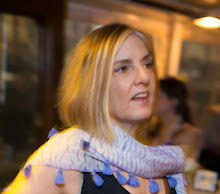
Tuesday, June 23, 2009


Crawfish Boil at my sister's house in New Orleans, May 2009.  The cracking and peeling and sucking of the heads went on for hours.  Mmmmmm!

Thursday, June 18, 2009

Finding Time and Strength to Write

Well, I lied about taking a break from the blog.  I'm thinking a lot these days about writing and how to structure my own life such that I nurture my writing life.  Since I've become a director of an MFA program (4 years ago), I've found it increasingly difficult to find the time I once was able to find for writing.  It's not just the time that the job takes, it's the fact that I can't leave it at the university.  It haunts me at home and in my dream life, and there's always something that needs to be done, or some small crisis that needs attending. 

Part of this is my own personality, of course.  I'm something of a perfectionist, and I really care about my program and students.  Building a program is not unlike writing a book, except that you are creating a space for others to flourish again and again, not just the one time they read the book.  These last four years have been rewarding in the sense that I feel I've been giving back some of what I've gotten from the world.   And I'm a pretty good administrator.

But positions like the one I have should be rotated, I think, especially if you want the writer who is in the position to stay alive.  I'm beginning to feel that I need to rotate out for a little while.  

Aside from the issues of free time  anyone might feel in a job that demands a lot of your energy, both intellectual and emotional, another issue for me is simple organization.  Sometimes the best way for me to get a poem or essay written is to put it on a To-Do list and make sure it finds a place in my calendar.  In fact, this is the best advice I could give to someone stuggling with finding the time to write:  put it in your calendar.  No matter how busy you are you, you can always find an hour to write, and if you schedule it when your body and mind are sharpest--for me it's the morning--you give yourself a better chance that you'll write something good.

Sharing your life with someone can also affect the kind of energy you bring to writing. When I lived alone it was easy to get up in the morning, grab my coffee, journal or laptop, and spend the first hour or so of the day writing before any other concerns infected the spirit of writing.  But now that I'm married to a journalist who likes to sit in bed with me in the morning and read his email and check out the international newspapers online, I find myself doing that--reading email and checking the news headlines--for about an hour instead of spending that time writing.   For my husband it's a shared time of bonding, and I feel that too and would hate to lose it--we do talk in the midst of sending emails and checking the news.  But it's also lost time for me because I do have to leave and go to the office to do administrative work, so I've lost that hour of creative work.  He's a freelancer and when I'm off to work he stays home and writes, and since he's a journalist, his searching of the newspapers is relevant.  Not always so for me.

Finally, there is the issue of what to write and what's worth writing about.  There can be times when you order yourself to write, when you write it on a calendar, you put it on your to-do list (Write that Brazil poem this Saturday!!!!) or when you negotiate hard-won space and time with your partner only to find that nothing comes, that nothing seems worth writing about, that nothing seems to inspire you. Then, I think, it's time to get at the root of the problem.  

People talk about "writer's block," but I think feeling stymied or paralyzed with writing is a side-effect of something else.  If you order yourself to write and you don't do it, well, it's like trying to stop drinking cold turkey without trying to understand the spiritual desires and other needs that drove you to drink in the first place.  

So an important step in trying to identify what's causing a slow-down in writing is to think about what's missing in your life.  If a poem or a story or essay is like a plant--let's make it a rose bush--what does it take to make it flourish?  Sun, just enough, water, just enough, good soil.  

When you are having trouble writing ask yourself about your sun, your water and your soil. And remember that we are all different and have different needs.  What are your needs?

For me it's time, space and the freedom and tools to explore what really matters in my life and the world.  And sometimes the news, email, facebook, it's all too much information, too much communication.  I still believe that the best writing gets done in a space of utter aloneness.

Maybe we don't need to "keep up" with everything--see Pico Iyer's comments on this in "The Joy of Less" :

 http://happydays.blogs.nytimes.com/2009/06/07/the-joy-of-less/?em


Tuesday, June 16, 2009

Poetry

I've decided to take a break from the blog for a bit in the summer to work on some poems.  I'm finding the need to work in the poetic form.  Although nonfiction is just as creative in many ways, there is something about the ability of poetry to incorporate wild or random elements that draws me to it.  There's also not the demand for literal truth that can seem oppressive after a while.  
Poetry has a smaller audience, but it has always seemed to me a great art form for spiritual growth and investigation.  

I've been working a little bit with a new tarot card deck (thus the previous post on the Eight of Swords) and have the idea to write some poems riffing off of certain cards and landscapes for a book. I'd also like to experiment with different voices in poems.  Next term I'm teaching a poetry workshop that will focus on persona poems and revisionist myth and fairytale poems, and it will be fun writing along with the students.  Maybe we'll use tarot cards as well!

Friday, June 12, 2009

The Eight of Swords


I am walking through an utterly destroyed landscape, a forest of trees and swords.  The trees are dead, and branches and swords lie on the ground.  Only an owl, a snake and a bat are alive.  If I could see them I would be happy, but I can' see anything.  Someone has blindfolded and bound me.  My feet hurt because I'm walking on swords.  I am aching all over, but I want to find my way out.  The moon seems full of energy but I cannot see it either.  I will have to listen to the snake, the bat  and the owl, creatures of the night, to find my way out.   I am determined that hurt, hurting, blind and bound, I will make my way out. 

It could be that a hurricane has come through this place.

Letting my Hair Go Gray


For the last year I have been letting my hair "grow out."  No more highlights, no more trying to hide the fact that my beautiful brown hair is turning gray.  While this decision has had a positive effect on my pocketbook (chemical hair treatments at a good salon can run $150 per treatment  if you get a cut and style as well), it's not been easy.

There's no getting around the fact that I look older with gray hair, even though I love the way it's streaked in the front, almost as though I'd been hit by lightening.  I would love for the gray to be utterly white, then I'd like like the bride of Frankenstein or at least Susan Sontag.   I look at photos of Terry Tempest Williams a lot for inspiration: she's let her hair go completely white, and she can't be much older than I am (54).  

And that's the point, really, to look older.  I don't want to be one of those women forever wanting to look younger than what they are, forgetting that we have a responsibility as the elders in our communities.  If we neglect mentoring younger women, if we want to be like them and not models for them, to whom will they turn when they begin to age and need to find positive role models? 

Still, when I recently traveled to Brazil with 10 beautiful young women about the age my son is, I felt keenly my age and how I had moved on to another country not only literally, but emotionally.

The translator who accompanied us on the trip is around my age, and we had lots of great conversations about aging.  She is Brazilian, but has chosen to live in the U.S. even though most of her family is still in Brazil.  She said this is because a woman past menopause is "nothing" in traditional Brazilian society.  People just don't look at you if you are older, she said.  Both she and Rita, the woman with the dreadlocks in the previous post (who is also around my age) dye their hair for this reason.  It's one thing for Rita, who is black and comes from a favela and still has the accent of someone who comes from a favela, to be discriminated against because of race and class, but it's quite another to be discriminated against because of age.  

It's inspiring to me that the situation is quite different in the Candemble religion as well as in the quilombo communities we visited in Brazil.  There, the oldest women in the village are honored and asked regularly for their blessings.  It is clearly a matriarchy, and I felt empowered to be among so many beautiful and wise older women.  I could see, from my students' journals that they perceived in very powerful ways, the beauty of these women (in the photos from my post yesterday).  

I am happy to be employed by a university that has a woman for a president, a woman for a vice president, and women in many of the powerful positions on campus.  Every day, when I walk our campus, I can feel that I am appreciated, that I matter, that every gray hair I earn will be respected here.  I just wish that I didn't  have to stay on my campus or go to a remote quilombo in Brazil to feel honored as an older woman in this culture.

Thursday, June 11, 2009

Women with Gris Gris: Brazil


I recently returned from a trip to Salvador, Brazil with students. One of the things that struck me the most while there were the women we met, especially the older women.

While there we visited a quilombo, a rural village founded originally by runaway slaves and in the case of the community we visited, the Engenho de Ponte community, also the site of a Candomble house.   The woman to the left is a rezadeira, or healer for the community who demonstrated to us how she makes her various syrups and potions, and gave us a taste of her syrup.  She struck me as incredibly beautiful and wise, and I struggled to capture that beauty in this photo.  
Both shy and strong in her knowledge, she reminded me a bit of my now gone grandmother.  

The woman in the middle at the top was the mother and leader of one of the villages in the community.  She is 94.  We sat on her porch while she told us stories of how the village came to be, of dreams and visitations from spirits.  She is the keeper and teller of stories for the community.  Earlier, when we had gathered together with members of the community in a circle and asked for blessings from whatever god or spirit we cared to, the children and members of this woman's village asked for her blessings.  It was then I knew I was in a truly foreign country.  My own family and culture honors traditional youth and beauty so much that honoring and asking for blessings from an elder would never happen.

The woman at the top left was the "mother" of the Candomble house, Mama Giovani, and is responsible for the spiritual life of the members of her community.  I found her story to be inspirational as well: she left the village to become a teacher, but returned because she was needed and felt a call. She said it wasn't easy to return, but her large and generous presence and spirit filled every space she walked. 

Finally there was Rita, the director of the Bahia Street project we visited (top right, dreadlocks).  Born in a favela herself, a practioner of Candomble, she has risen to become the director of a non-profit organization that focuses on helping young girls escape the cycle of poverty and violence that awaits many of those born in favelas  in Salvador.

This post is mostly about getting these photos up--trying to figure out how to post photos.  I will write more about what struck a chord in me with respect to these women in my next post.


Wednesday, April 1, 2009

Oyster Po ' Boys

Such a warm and beautifully rare sunny day yesterday in Pittsburgh! 

I've been planning a trip to New Orleans to visit my mother, and my thoughts have turned to spring in Louisiana and the great spring feasts we have of crawfish and crab and shrimp and, of course, our beloved oyster.  I love oysters any way and all ways--raw, baked in the shell with or without topping, sauteed, chopped and mixed into dressing, cooked into a gumbo, but my favorite and most sinful way to have them is fried on a loaf of French bread, a few sprinkles of Tobasco and ketchup, shredded lettuce and fresh Creole tomato slices, sliced pickles, a cold beer to wash it all down.  We call this creation an oyster "po'boy."  The oysters are battered and fried so they're brown and crispy on the outside and hot but just barely cooked on the inside.  Louisiana French bread has a flaky crust and an airy center.  The crust is so flaky, in fact, that you cannot eat a po'boy without getting crumbs all over you and this is part of the joy of it.  If you order a po'boy you'll also be asked if you want it "dressed," which means do you want it with lettuce, tomato, pickle, mayo.  Be careful how you answer this question.    Don't say you'd prefer it naked if you don't want it dressed. Just say you want it plain or without anything.

My father, who often stayed out after work drinking and carousing, would sometimes buy my mother a po'boy on his way home.   He'd give it to her as he stumbled in, warm and wrapped in butcher paper, a sort of peace offering.  For the longest time I thought of this as  a unique and somewhat touching story about my family--my mother loved po'boys. But Jay Harlow, in his book The Art of the Sandwich, suggests that the etymology of  po'boy is from the French pour boire (peace offering),  and that men (lots of men, not just my father) would often come home from a night out bringing the po'boy as a peace offering.  So that it seems to be a cultural phenomenon, not something particular to my family.

There are lots of other speculations about where the expression po'boy  came from, including that it was a sandwich served to poor working men, but I like this explanation the best because it fits my family story so well.

I like to think of my mother sitting in the kitchen as a young wife and mother, her anger at my young, drunk father who is already in bed subsiding as she opens the butcher paper and finds a warm po'boy waiting for her, already cut in two.  I imagine her grabbing the tabasco bottle that was always on the kitchen table, sprinking some drops on the oysters, maybe some lemon and ketchup, her mouth salivating, and biting into it, the crumbs falling all over her nightgown, the glorious mixture of the crusty bread, the crisp fried oysters, the shredded lettuce and tomatoes and pickles blessing her throat, the hot sauce reminding her of my father, and maybe as she eats she thinks of him and how he'd sit outside the house during oyster season with a sack of them, naked from the waist up, using a knife to cut open their shells, so like a woman's sex, if a woman's sex could be petrified, stabbing the flesh and eating them off the tip of the knife cold and sweet and salty.  

Maybe she'd forgive him, maybe not, maybe the oysters worked their gris gris on her and she'd slide into bed next to him when she was done, full, pouty, but feeling just  a little bit sexy.  He'd be snoring, his back turned to her, but she'd lie next to him, press her now rounded, full of oyster po'boy stomach against his back and sleep.

The best oyster po'boy I ever had was at Salvos in Belle Chasse, Louisiana.  Hole in the wall working class deli and restaurant. Very noisy, very cheap:  heavenly. 

Tuesday, March 31, 2009

Endings

I've spent this semester thinking and writing about playing a video game, and I think I've now come to the place where I want to stop the actual playing and focus more on reworking these blog posts into essays.  So I think most of my future blogs will focus on other issues that are engaging me right now, including, most recently, travel.  

Last night I attended the Marjane Satrapi talk in Pittsburgh and was moved and entertained by Marjane's presence: her sense of groundedness, her sense of humor, her pragmatism and honesty.  I saw in her some qualities that I sometimes find in myself when I'm at my best, and seeing her on the stage gave me a renewed sense of of self in an odd way.  Her discussion about comic books reminded me a bit of video games.  In the same way people want to call a comic book a "graphic novel" because they're embarrassed to be caught reading comic books, so are academic types often embarrassed to admit they play video games, although both comic books and video games are simply new forms to deliver both information and stories.

I was also interested in a stray comment she made about what she is writing about now.  She talked about working on a movie and said something like, "It's about Iran because that's what I know, it's what I am, what I know best."  She doesn't seem to feel like she has to move on to something else, that, for better or worse this is her subject.  I have felt that way about my family, about Louisiana, that this is what I know best, but have also felt the need to break away from that, and this experiment with writing about WoW is one attempt to do just that.  As much as I have enjoyed the freedom to think and write about playing this game, and as much as I do believe I'll generate some interesting essays about it, writing about the game feels a bit empty somehow not thick enough, not layered enough, because of course, no matter how much you bring to it, it's not reality.  There's no blood when you kill in WoW, and if there were I probably wouldn't play it.  I know lots of games where there's lot of fake blood when you kill, but it's fake and you know it.  There are no smells, no real animals, no real land, no real water, no real food, and even the colors and impressive landscapes seem one-dimensional.  What I've learned is that there are real relationships that can develop between people in these games, though, and perhaps that's one of the attractions of the online games.

I've recently had an awful thing happen, so awful I can't even write about it in this blog (although I will, in time).  It involved a betrayal on the part of a colleague and friend, a betrayal that also damaged someone for whom I have responsibility.  I've spent the weekend depressed and sad and knowing that I can never count on this person again, and that my own work for the next year will be in some sense doubled because of this betrayal. An ending.

Although I'm sad about the betrayal and a little sad that I'm moving into a new stage of the video game writing project, both are endings that imply a new start, the excitement of new essays possibly published in print form (I still get excited, after all these years, by the prospect of publication), and a new shape to my own work because of this betrayal.  I remember that when the winds of Katrina knocked down the huge oaks I loved in a forest in Algiers, the space in the forest canopy allowed some of the stunted oaks and other saplings that were hanging out in the dark, to shoot up into the light, double their size and girth in less than a year. Something lost, something gained, my mother used to say. 

A death, a birth.  A loss, a  rich soil for planting  new seeds whose hulls will break open in the dark, their green fingers clutch through  dirt, reaching for sun.  

Saturday, March 21, 2009

Haunted by the Past

I have now played through the transformative moment for the Death Knights (called DKs in the game) where they turn away from the dark side and embrace the light.  How this happens is not as interesting to me as how the past follows the DKs in the game.  Initially, when they enter any city the citizens throw things at them, spit on them, call them names, taunt them because of their shameful past.  Eventually this stops as the DK starts to work for the "good."   The game goes on just as it would for any other high level character, for the most part, except that the DK character has a very swift horse, exceptional (blue) armor and a very cool way to zoom back to her home no matter where she is in the world.   She could almost forget that she was ever working for the evil one.  And it seems as if the game wants you to forget.  But I can't.

I feel ashamed when I play the DK character.  I remember only too well what that character did. Although the character has a swifter mount and way cooler armor than any of my other characters, it feels to me that the armor and mount was not earned in an honorable way, so I have mixed feelings about it.  The DK is still profiting from her evil (she hasn't given away the mount or the armor),  just like those CEOs who in the recent news have received huge bonuses for plunging the stock market into the abyss, so she, like them, is still to be despised.  

I haven't deleted the DK character, but I haven't played it for while.  I've chosen to create another character, a Troll Priest, who has weak armor, a slow, lolling gait, and skills that focus on healing.  She's very slow, and has to use her skills at healing herself to survive in any fight. She has to be more resourceful than a DK and can avoid fights by screaming at attackers and scaring them away so that she can run away.  And I am leisurely playing that character for now.

I just returned (in real life) from southern Mexico  where I travelled for two weeks on a delayed honeymoon with my husband (more about this in a future post).  I rarely thought about WoW; the landscape of the Sierra Madres and the culture of Mexico was so compelling I didn't have much time or desire to think of anything else, especially a fantasy landscape.  But I picked it up again when I returned.  Television has become so boring to me; except for the news I could happily never watch another TV show, but my husband does like to watch TV for a couple hours each night before going to bed.  So while he's watching TV, I'll play this game for R&R, unless I have papers to grade or books to read for the classes I'm teaching.  

We had the poet Alicia Ostriker, someone I've known personally for about 20 years,  to visit at Chatham last week, and I was pleased to have the opportunity to catch up with her.  We had engough time talking that I began to tell her a little bit about my playing of this game and my desire to write a book or series of essays related to the playing of the game.  She seemed to agree that the experiences were interesting, but at one point asked  "So are you addicted to this game?"  

Of course I said no.  I play about an hour a day, I said.  But this reminds me of the alcoholic who says she isn't an alcoholic, only has two drinks a day (forgetting to mention the times she has three or four or sometimes passes out).  Sometimes I play more than an hour, especially on the weekends.  And I think about it a lot, although in all honesty I am obsessive about anything I plan to write about seriously, so this is no different.  But the real truth is that I have thought a lot about addiction;  I've written about drug and alcohol addiction extensively in my poetry and essays (both my brothers, my aunt and father died early of drugs or alcohol), and I have thought all along playing this game that it would be useful for me to explore why and how video game addiction occurs, and to try to write about it.  Since I came close myself to falling to the same addictions my father and brothers fell to, but survived to tell about it, I figured I might have the strength to survive this and write in a compassionate way about the desire to play these games such that those of use who don't play (and especially mothers and fathers) have a first-hand account from someone who's been there.  

But just as I'm haunted by the past actions of the DK figure, I'm haunted by my own past and the past of my brothers and father.  I feel that darkness in my fingers when I move my characters around the screen, when I furtively look at the clock to see how long I've been playing, when I rush upstairs to play after work or when Teake leaves to go to the store.  I'm playing with fire, and my fingers know it.


Monday, February 23, 2009

The Dark Side

The Lich King expansion for WoW offers players the opportunity to create a "Death Knight" character and to work as a high level assistant for the Lich King, who very much resembles Darth Vader.  The head piece that the Death Knight characters start out with, a cowl that shades part of the face resembles that worn by Darth Sidious, a Dark Lord of the Sith and perhaps the most evil of the characters in the Star Wars saga.  

In order to create a Death Knight, you must have reached a level 55 character on the realm you are playing, as Death Knights start out at level 55.  You have to give up your other character, at least while you're playing the DK, so it seems, psychologically, that you have died and been reborn as a soulless, mindless death machine.  The Lich King gives you orders to kill wantonly and without conscious, at one point ordering you to kill a number of citizens who are unarmed and who tremble and beg for their lives when you approach them, citizens who do not strike back, for the most part, when you attack, wielding your glowing, runed sword.  The Lich King "whispers" to you in the chat box should you falter or think not to strike.  No mercy, he says, when a woman with several children begs for her life.   There is no light, only dark, he whispers.  In another scenario you are ordered to spread a plague to the miners working in a nearby mine.  The more you kill, the more rewards you get, and nowhere in the game have the rewards been greater: almost every quest in the early part of the Lich King nets you a rare piece of armor. 

Prior to Lich King there had been times when I found my character doing something morally reprehensible, something I would never have done in real life:  killing animals that were bordering on extinction in real life, for example.  Of course I've never killed anyone in real life, but in the game as long as there was a narration that justified it I didn't feel so bad about it.  It's just a game, after all.  But Lich King makes you do horrific things, over and over again, and I am finding it deeply disturbing.  The only reason I'm continuing to play is because a review I read of the game suggests that something huge happens and transforms the game, making the DKs more acceptable in some way.  I'm waiting for that something to happen, but I don't think I can last much longer.  

I do have the feeling that my character is being trained to love evil and relish killing.  Since the game has strict rules, it doesn't seem as if I have a choice if I want to keep playing a DK.  Obey or die.  But it gets easier, killing the helpless citizens, especially when the rewards are great. And that's disturbing as well.  I wonder if there are other games like this with the opportunity to play such great evil, and I wonder--to what end?  I have always known that I might reach a place in this game-playing where I would not, could not go, a place where the game ceased being a game and instead seemed to be infiltrating too deeply into my core self.  This is, of course, what parents and educators have all along feared with respect to these kinds of games. It's one thing to find yourself pitted against a powerful Dark Lord, but how to play one yourself, "for fun"?  

On the other hand, isn't this what fiction writers or actors have to do to get inside the heads of serial murderers or other evil creatures?  What did Doestoevsky have to do to create a character like the amoral Stavrogin (who rapes a little girl) in The Possessed?  How about Heath Ledger's portrayal of The Joker?  

The question for me:  is it valuable to ask the children who play video or computer games to actually play pure, unrepentant evil?  Is it valuable to teach them to savor or enjoy killing the helpless, to laugh at their pleas to spare them?  

Or am I afraid of the darkness that I sometimes find within myself, so afraid that I don't want to enter into a game space where I have to come too close to it?  The most horrifying thing my mother ever said to me:  We are all capable of anything, Sheryl.  Anything.


Saturday, February 21, 2009

Peacemaker

My husband does not like video and computer games.  He does not like how they seem to have stolen his son (now my step son)  from him, he does not understand the hours and hours his son can sit in front of a computer screen, utterly absorbed, clicking and clicking at something his dad does not understand.  He thinks video and computer games are partly responsible for the lackluster performance his son has had in high school.  

He is right to be concerned, but I have also tried to get him to look at the games in a different way, to enter into the games such that he understands the attraction.  Keep your enemies close, I say to him.  I have not been successful.  Although he will come in my study and peek over my shoulder during my nightly hour of playing, I cannot get him to play a character himself in WoW, even though I have created a male warrior character called Teake, which I sometimes play. In a future post I want to write about what it feels like to play a male atavar, but not today.  

The other night, after our evening crossword puzzle, I could see he was in a generally happy mood, so I asked if he'd play a  "little bit" of the game "Peacemaker" with me.  Peacemaker is  a game designed by Israelis, Palestinians and Americans based on real life events that simulate the tensions between the Israelis and the Palestinians.  Teake is, in real life, a journalist, and a Dutch citizen and is extremely interested in world affairs. 

In this game you have to choose between being the leader of the Palestinians or the Israelis, or you can let the computer choose for you. Since we had to share power (you can't play against a human player in the game), and since we could not agree on who we wanted to play, we let the computer choose for us:  the Palestinian leader.  

There are lots of things I could report to you about playing this game:  I could report to you, for example,  that there are not enough options in the game and  that it seems an impossible game to solve, and that these things probably reflect the way things are in real life. I could tell you that the graphics were not very interesting, but that the text was, and that one could learn a lot about the history of the Palestinian/Israeli conflict by playing the game, and these things are all true.  

But for me, what was most interesting was the dynamic that developed between Teake and me as we shared leadership and made decisions about what to do as the leader of the Palestinians. The first thing that became clear was that we could not agree on how to lead. Every time something happened that demanded a response (a suicide bomber, Israeli attack, etc.) Teake wanted to do one thing and I wanted to do something completely different. I don't know that there was a pattern early in the game--sometimes I wanted to build things to make our infrastructure better, sometimes he was the one wanting to build.  Sometimes I wanted to make a speech to the world and sometimes he was the one wanting to make a speech to the world.  All of the projects we wanted to do cost money, however, and we constantly ran into problems trying to get world leaders to loan us money for our various projects.  

We decided to take turns deciding how to respond, although each time we criticized the other's decisions.  I think we were trying to do what westerners would consider the "right" thing, but it seemed that everything we did was criticized by one faction or another, and our approval rating internally and with the international community continued to plummet as we kept trying to do the "right" thing:  help the poor, relocate refugees to better places, build better educational systems, appeal to the international community, etc.  We had avoided any escalation of violence, to no avail.  After an hour of play, we were losing big time.  "Losing" involves reaching a certain level of unhappiness with both the internal and the world community as reflected in real numbers.

Teake, I should mention, hates to lose.  

"Let's just start blowing things up," he finally says when it seems that none of our good-nik solutions are getting anywhere.  

Needless to say, we lost.  

We did come away from the game with some sense of how incredibly hard it is to govern and to share governance in such a volatile part of the world, although we sort of knew that already.   I don't know if Teake will want to play the game with me again or not.   I know, from playing other games, that there must be a strategy that lets you win, that we just have to figure it out. 

But I don't think Teake will want to do what I know we'll have to do again and again in order to win: lose and lose and lose and lose.

Monday, February 9, 2009

Playing the Enemy

Two factions dominate in W0W:  the Alliance and the Horde.  When you create a character you have to decide to which faction you want to belong.  On some level, the Alliance are the "good guys."  They include the beautiful-bodied humans and cerebral night elves, as opposed to the broken and bestial looking trolls, orcs and "undead" of the Horde, who seemed to me, at least initially, to clearly be the "bad guys."   Even the names of the two factions, Alliance and  Horde suggest that one is more organized than the other, the Alliance a group of like-minded, rational creatures, the Horde a swarm of less organized, warring factions.  If we were to make a comparison to real life, the Alliance might be seen as like the European Union or the United States, and the Horde might be interestingly compared to terrorist groups from Iraq, Afghanistan and the like.

Of course, good girl that I am, I wanted to play the Alliance.  I couldn't imagine at first why anyone would want to play the Horde.  Why would anyone intentionally want to play the "bad guys?"  I mumbled something about this to my step son, who looked at me quizzically, said "That's not what it's about at all," but wouldn't elaborate.  Later, when I suggested we do some questing together in the game he said "I'm Horde."  Alliance and Horde cannot quest together and indeed cannot even speak to each other in the game.  

It struck me then as an interesting way to think about teenage sons and the way they sometimes perceive their relationship with their parents:  we are the Alliance, they are the Horde.   Of course they would be interested in any kind of creature that fights viciously and passionately against the rules and limitations of society.  This is why the Hulk is so attractive, and many of the orcs in WoW, to pick one race resemble the Hulk:  their skin is dark green, their bodies stocky.  In addition they have fangs and wide, grimacing smiles, not unlike a Gorgon mask.

But there's more to than that.  After having played an Alliance character to a high level, I started the game over, this time playing a Horde character, a troll.  While the other Alliance characters I had played were beautiful in a Barbie-doll sort of way, there was no way to create a troll character that is anything but hideous.  Big-footed, big-nosed with tusks of varying sizes, they have blue or green skin and a pronounced slouch (humans and elves never slouch).  They don't run in loping, balanced cadence like humans or elves but rather have an awkward, lopsided gait.  Their speech and culture in the game mimic that of black Jamaican culture, which is a whole other subject I'll talk about another time.

Playing a troll character means transforming my mind set so that all the characters in the game I am used to seeing as enemies (and I killed lots of trolls as an elf) I now recognize as friends.  I am now able to enter all the enemy camps and home cities that I could not enter when I was identified as an Alliance character.  I hear different narratives--the other side of the story--if you will, from the Horde quest givers that justify whatever actions I might be asked to take against Alliance characters.  I find myself feeling compassion for this wounded, demonized group of characters.  I see things in the landscape that I hadn't seen before:  how most of the Alliance groups live in traditionally idyllic environment with trees and lakes and rivers, whereas the Horde lives in barren and wounded and destroyed environments.  Esther MacCallum-Stewart has pointed out in her excellent essay "War and Histories in World of Warcraft" (in Digital Culture, Play, and Identity: A World of Warcraft Reader), the Horde "worship nature in all its forms" while the Alliance "are only happy with a conventional, fertile landscape that they have quickly industrialized." (43)  MacCallum-Stewart presents a nice analysis of the environments of the two groups and how those environments shape our perception of the two groups, pointing out that the Horde's cities reflect an "ability to creatively remodel terrain," while the Alliance cities are modeled after long established types of cities such as medieval castles and mountainside fortresses.

Many years ago I wrote my PhD dissertation on the figure of Medusa.  I was attracted to her because of the paradox inherent in the many versions of her stories: in one version it was her beauty that turned men to stone, in another it was the horror of her horrifying Gorgon face.  In yet another version it wasn't snakes but dreadlocks that crowned her head and she was the head of a tribe of Libyan female warriors.  I was also interested in thinking about why so many American female poets (like Sylvia Plath, May Sarton and Rachel Blau DuPlessis to name only a few) had written poems in the persona of Medusa and seemed to be attracted to her as a muse. As creative relief while writing the dissertation I began writing poems in the voice of Medusa. She became an actual muse for me, drawing me eventually away from the critical writing I would do in the dissertation and into another world:  the world of poetry.  I began to see something in her character that had the kind of creative agency that I can also see at work in some of the Horde races from WoW.  When you are not given the blessing (or curse) of a beautiful body and face you must rely on imagination and creativity to move successfully through the world.  It is the difference between the passive and beautiful Snow White, and the endlessly inventive and creative witch of a stepmother, as Gilbert and Guber point out in their classic work Madwoman in the Attic.

Free from any semblance of beauty or need to attract, on a physical level, a male, my Horde troll character lumbers through her destroyed environment, making things up as she goes along, first trying this and then that before succeeding.  Her cities feel more like communities and families than the Alliance cities do.  Merchants and quest givers call me "child" and dance when I come to them with a question.  When they speak they speak in an informal Jamaican dialect.  

At the very least playing the enemy has taught me once again that things are not always as they seem and that there are always two sides to a story, that truth is always complicated, and that the way we see the world is colored by our race and our assumed place in the world. It's not that I didn't know these things before, but I knew them intellectually, not in my body. Playing the game has allowed me to experience two sides of a conflict in a very physical way.  Getting a poem by heart, memorizing it, teaches us so much more about the bones and spirit of the poem than simply reading or analyzing it on the page does.  Same thing for playing music. You can read the notes or you can internalize a song or piece and play out of that internalization. So too does enacting, physically, the other teach us something that is perhaps more lasting about cultural understanding than simply reading about it.  

A group of American, Palestinian and Israeli students at Carnegie Mellon designed a serious video game called Peace Maker that is about the Israeli-Palestinian conflict. It is available commercially from the independent games publisher Manifesto Games.  The game allows you to play the leader of the either the Israelis or the Palestinians as you make decisions about situations that are taken from real-life events.  I've ordered the game but have yet to receive it. This is just one example of a serious game that could have extraordinary educational impact that has come out of the entertainment gaming industry.  For anyone interested in peace and video games, I'd recommend attending the upcoming CMU conference, 'The Future of Interactive Technology for Peace" April 2-3.  Google it.

For the Horde.

Saturday, February 7, 2009

Killing Yourself in Cyberspace

Like most adults I know, I get up five mornings a week to work,  go to the grocery store a couple times a week, go to the movies a couple times a month, and also like most adults I know I've contemplated suicide once or twice in my life, looked at the gulf of meaninglessness and hopelessness and cruelty and violence and wanton destruction and depravity and corruption that sometimes seems to define life on earth (not to mention misery, sorrow, regret, terrifying acts of god,  and coming from a screwed up family). What's the use, who cares, why go on with it, we think.  But most of us sleep on it (sometimes after lots of wine or beer), wake up, and do continue.  We find, or create, a reason to go on.  We look, as they say, at the bright side of life.  Or, failing to find a bright side, we create one, or pretend there is one.  Especially if we have children we pretend there is one.  

But what if you just don't see a bright side.  What if you find yourself surrounded by people who seem to hate you, more, want to kill you?  Say you run away, you jump off a cliff into the ocean thinking to end it all, only to find yourself still alive.  The drop not as steep as you had thought, the water  kind.   Surrounded by cliffs, you'll never survive a swim half way around the world, so what do you do?  You really wanted to die.

You press the x key, which makes you sink to the bottom of the ocean and you wait there, very still.  

After a minute or so bubbles start coming from your mouth, you are choking, you are taking in water, your health is declining rapidly and in bright red letters:  -400, -800, -1500. It is alarming, but this is what you want.  You are watching yourself die. You are killing yourself. You make a final jerky move and then you're dead.  You've drowned yourself.

There are a couple of good reasons to kill your avatar or let yourself die in WoW.  You always resurrect in a graveyard near where you died, and sometimes if you are trying to get to a difficult place where there are lots of monsters, it's easier to kill yourself and resurrect in a graveyard that is nearer to the place you are trying to reach.  Another reason to kill yourself is if you have fallen into an ocean surrounded by cliffs and it will take you 45 minutes to swim to a place where you can safely climb out. It's quicker to kill yourself and start over.

It's just a game, right?  

Right. But I felt really creeped out watching myself purposely kill avatar recently.  It felt deeply unnatural, even though it was just a game, even though I knew I would resurrect.  In those minutes sitting there watching my avatar die I couldn't help but think of the people in my life who have killed themselves and never resurrected, and the others who threatened it but haven't yet gone through with it.  What perceived hatreds, what monsters, what cliffs too high, what love too lost, what hope too frayed, what waters too deep to keep that finger pressed on the x button, no resurrection in sight.


Wednesday, February 4, 2009

Thinking about Blogs and Journals

Now that I've been blogging for a couple months I've had a chance to think about blogging and how it compares to journaling.  There are certainly things I don't want to say in a blog that I would say in a journal, so there's definitely one level of self-censorship.  There are even things Idon't mind publishing in a book that I don't want to put in a blog, maybe because it seems easier for a blog to be excerpted and taken out of context.  There are things I wouldn't write about members of my family in a blog; although most don't read books regularly, they all are on the internet (facebook, etc.).  

Of course you can set your blog so that no one can see it.  

I'm also not so sure about using a blog to write bits of a memoir.  Although my previous blogs have contributed to the piece I'm writing about playing WoW, I'm not so sure the structure of the blog is a good one if you want a longer, book-length work, to have an uninterrupted narrative arc.

I still think blogs are useful for creative writing prompts, especially shortish pieces, and for exploring new ideas.  I know a lot of people use blogs as intellectual journals, places to reflect on all kinds of things, but I'm mostly interested in seeing what kind of role they might have in the imaginative life, what role they might play in helping us to write more and better and be disciplined to write more and better.

Friday, January 30, 2009

Weather

It's snowing outside, and I love how the neighborhood outside my window is encased in a soft layer of snow.  Everything is rounded and softened; the sharp lines of the stiff, tall Pittsburgh houses seem relaxed, just a little.  It's a time to be curled up in front of a fire, but I'm curled up in front of my computer, pillow for my back and afghan for my lap, cat at my feet.  In some ways the computer may have taken the place of the roaring fire that kept us warm through a cold night.  Or maybe it's more like being curled up with a book in front of a fire.

At any rate the weather outside is not the same as the weather in Azeroth where I'm currently questing in Stranglethorn Vale, a coastal rainforest where it regularly storms.  Right now it's pouring rain and difficult to see as I pick my way through thick brush, trying to avoid apes and panthers, tigers and pirates.  

This is both the beauty and the darkness of video games.  For a space of time you can separate yourself completely from whatever the weather is outside, or the situation.  I look up from time to time to watch the snow falling and admire the softness and beauty of it, then turn back to a hot, steaming jungle where the rain pounds just as it does in real life, and sounds just like it does in real life.   I am in a strange world where I'm not completely separated from the real world and its weather, but  mostly.  And I could let myself fall even more deeply into the imagined world if I could.  I could forget, for a moment, about the deep troubles our country is suffering from, I could forget that some of my friends are losing their jobs, that my son is having to donate blood and sell his belongings to pay his rent, that there's no amount of money I could send him that would help his life to be sustainable at this moment, that his chances of finding a job are almost zero at this precise moment.  Even though I had nightmares last night about my son, I can enter into Azeroth and put those nightmares aside for a moment, fight monsters that I actually can beat.  

Although the world Blizzard has created is astonishingly beautiful and horrifying and mimics life in many ways,  it is still romanticizes poverty and suffering.  No one has to give blood to pay their rent in Azeroth.  No one is selling their books and CDs and music equipment to buy food in Azeroth.  If you're poor in Azeroth you can always earn money by mining or selling herbs or equipment or potions you can make.  The only blood that's spilled is when you kill monsters or are killed yourself, and even then, no blood is ever shown on the screen.

My son's arm is bruised and swollen from the nurse who last took his blood.  There are never any bruises in Azeroth, never anything swollen.  In this world we don't want to be reminded of the wages of suffering.

Wednesday, January 28, 2009

Engagement

I have been reading Hamlet on the Holodeck: the future of narrative in cyberspace  by Janet Murray and find myself deeply engaged with the book, reading it as if I were eating a delicious 10 course meal and can't wait to get to the next course--or chapter in this case.  Murray looks at the kinds of imaginative worlds that now exist in cyberpace from the perspective of someone with a literature background, and I really appreciate the depth that perspective brings to the understanding of narrative.  She's also well-versed in science-fiction narrative in general, including the Star Trek series, and since I know every Star Trek episode from almost every incarnation of the series, I'm right there with her.  

It's interesting to me that I find myself more engaged with this book than a recent book I assigned students to read for our memoir class.  The book they read is a good read:  it's funny and poignant and offers comic insights into the life of a young woman in America and her exploits and travels.  But I find as I age I want even more from a book.  I remember a line from a poem by Brenda Hillman that was at least partly about forced entertainment (i.e., we WILL all go as a family on vacation to Disneyland and we WILL enjoy every minute of it):  "Fun," she wrote, "is sad."  In order to enjoy myself I seem to need to be challenging myself in new ways and learning something new.  Learning, for me, is fun.  Being challenged by a book or a game or some new knowledge is, for me, fun.  Being entertained, especially entertainment that is being done to me, rather than something I'm participating in, is not fun.  This is why I do not stay up late with my husband to watch the Jay Leno show.  I would rather retreat to the world of Azeroth where I can kill orcs and save polluted kingdoms, and discover new people and new lands.  

This is perhaps also why I enjoy political satire over any kind of writing or speech that is merely funny.  I can listen to John Stewart, for example, without getting bored or feel that I'm wasting my time.  

It's harder, as I get older, to find writings that really really engage me, that break some frozen sea inside of me, that teach me something new.  This is also why, I think, I'm so interested in the possibilities of narrative and imagination in video games and cyberspace.  It's just beginning to be explored and it feels as exiting to me as modernist poetry did at one time.  

Sunday, January 25, 2009

Cruelty

There are three different realms available for play in WoW:  one is a Player-vs-Player realm where players can attack each other at any time without rhyme or reason.  Another is a Role-Playing realm where all players agree to stay in character, and where no player can attack another without the specific consent of the other.  The third is a role-playing realm that allows PvP attacks. 

I prefer the Role-Playing realm because I don't like the idea of having to worry about players attacking me for no reason, and because I'd rather play the game against (and with) the environment.  Players will sometimes ask if I want to duel and I always say no.  Sometimes they don't take no for an answer and keep following you around and asking for a duel, and sometimes they insult you, hoping, I guess that the insult will provoke you to attack them. Such was the case when one player whispered to me once  how awful my armor was.  Instead of attacking him, I just became sad and insecure about my armor.

One recent interchange that I found disturbing involved another player,  a blood-elf, who hid himself in an area where players would normally go to turn in quests.  He had PvP turned on and somehow was able to attack me (I haven't quite figured out how this happened yet, as I didn't have PvP turned on.)  At any rate he was at least 10 levels above me so he would have killed me within seconds.  I pretended to be dead (you can "feign death") and watched him, and an associate, who also appeared from nowhere as they proceeded to kill my pet raptor.  He and the associate then began to spit on me, and emoted that they were "laughing maniacally."  They kept spitting on me, and once they realized I wasn't really dead, attacking me until I died. 

I figured they'd had their fun and would move on, so I resurrected (this is a process whereby you find your spirit at a nearby cemetery and travel back to your corpse where you resurrect at half the health you had).  It is considered bad taste to attack someone when they have just resurrected because it brings no honor to the attacker:  the victim is already in a considerably weakened state and easy to kill.  

These two were waiting for me, though, and they attacked, spit and "laughed maniacally" until I died again.  This time I didn't come back but stayed at the cemetery where you can ressurrect for a considerable penalty if you don't want to try to find your body.

Of course I've witnessed cruelty of all sorts in the real world, and this small bit of cruelty in a virtual world shouldn't have bothered me as much as it did.  At the end of the day I didn't lose anything that valuable, just a bit of time, and I wasn't physically hurt.  But it did bother me, maybe because the kind of cruelty that bothers me most comes from those I can't see.  

Recently my real-life car was vandalized:  some unknown person or persons spray-painted "BLOODS" all over the entire passenger side of the car, covering both car doors as well as the windows.  I have been unable to get the paint off and will wind up having to have the entire car painted.  Our garage was also vandalized around the same time, with odd symbols from a gang around the neighborhood painted all over one side of it.  When the vandalism happened, I wanted to know who had done it.  It mattered to me.  I wanted to face the vandals and tell them what cowards I thought they were.  If you're going to be cruel, I would have said, be cruel to my face.  Do something to me where I can see your face, not in a dark ally at night when I'm sleeping.  

And I wish I had had the opportunity to see the faces of my attackers in the virtual world as well.  Maybe it wouldn't have mattered.  Cruelty is cruelty whether you know the cruel ones or not, whether you can see their faces and smell what they had for lunch on their breath or not. But it seems to me that cruelty in a virtual environment is especially cowardly and deserves a special place in hell.  

Tuesday, January 20, 2009

Playing

I seem to have a huge need for significant down time in order to be as productive as I am in my professional life.  And I am productive, and efficient when I am writing, teaching or administering the MFA program.  But when I'm "off" I want my off-time to be efficient and productive as well.  I used to read for fun; home after a long day teaching or grading essays or commenting on poems or writing myself I'd curl up with a few books for fun.  But reading no longer seems like fun to me. I spent 90% of my life reading books and student work, and I want to do something else in my down time.   So games provide me with a way to be "intensely idle."  At the end of an hour playing a game at night I feel invigorated and challenged, as if I had taken a brief vacation, and in a way, I have.  I've gone to another world for a hour, one that didn't cost anything but a few pennies at most, and hardly any fuel fossils.  I'm ready to go back to reading and writing and teaching.  

But I think I must also have a gene for wanting to have fun, if that's possible.  My husband thinks my family has some kind of addiction gene and that I have found a way to make that a positive thing by becoming obsessed with whatever it is I'm doing, whether it's planning a conference, teaching a class, doing research for a book or playing a video game.  There may be some truth to that, but I think there's also something there about having fun.  My parents loved to have parties--in their early years they danced and bowled and had people over for escargot and card games.  No one else on our block did anything like that.  I should mention, maybe, that we were Catholic, and it always seemed to me that Catholics had way more fun than Protestants.

At any rate, I also remember my grandmother  liking to have fun, to dress up, to play games with us, joke with us.  We all liked very much the partying that went on at Mardi Gras, the disguise, the fun of it.  We were not a sober family, although my father worked very hard, at two jobs and sometimes more when he was alive.  He played very hard, though, when he wasn't working.  

When I was a little girl, one of my favorite past times was playing with paper dolls.  I loved cutting them out oh so perfectly, then cutting out their clothes, putting them on and taking them off, making them have dinner, or go out on dates, or fight with each other.  I loved doing the same, later, with Barbie dolls, dressing them up and imagining different situations for them.  On rainy days I'd sit all my dolls and stuffed animals in chairs on our porch, set up a chalk board in front of them, and play "school."  

It's clear to me that the playing I did as a child prepared me for some of the successes I had later in life:  it engaged and honed my imagination, and allowed me to imagine scenarios where I was, in fact, the leader, faced with crucial decisions (what should I do about the fact that my Midge dolls didn't seem to want to learn how to spell? Or that Chatty Cathy didn't want to learn to read?).

Sometimes I think the electronic characters I have online are just a more advanced version of  the paper dolls I had as a child. For what might all this killing and dying, over and over again in the game, be preparing me?

Sunday, January 18, 2009

Angel in the House

When I first began playing WoW (World of Warcraft) in a serious way, and by that I mean about seven hours a week during which time I also journaled about my experiences, I thought I was a freak.  I wanted to understand what it was my son found in these computer games, and I figured  that  most of the people playing  were young boys.  I've since learned that women represent 38-40% of the gaming market, with most women playing games about 7.4 hours a week.  Which means that of the over 10 million who play WoW, about 4 million are likely to be women.  There is even a website (www.womengamers.com) for women who play.  

I've also learned that many women who play are over 40 and college-educated.  One women, a PhD anthropologist, spoke of "gamer shame"--that it's difficult for her to talk with her colleagues about the fact that she spends her free time playing games.  Many stay-at-home moms play games after they put the kids to bed.  I've  met a number of retired women professionals who play regularly.  Other women I met through the game admitted they had originally gotten interested in the game through their sons.  Some joked that they were addicted.  

And yet marketing for games continues to be addressed to a primarily male audience; the IGDA reports that 88.5% of game designers are men.  This is one reason why WomenGamers.com has initiated scholarships for girls to attend National Computer camps during the summer. Ubisoft, a large independent video game creator in Europe has also formed a group of female gamers for girls who may have been too intimidated to play games online. Women have also begun to complain about the objectivation and hypersexuality of some of the female online characters, so much so that Lara Croft's excessive breasts have been slimmed down some in the most recent version of that game.  Games that feature violence against women or protrayals of women as weak and helpless are targeted by groups like NOW and Media Report to Women.

I have  a couple of different avatars I play in Wow.  One of my favorites in a dranei hunter.  The dranei (the name means "exiled ones") walk upright but have horns and horse-like legs.  The females have large breasts and large behinds with tails that swish like horses do when swatting flies.   The clothes and armor available this character are tight, sexy and often more revealing than anything I'd wear in real life, at least since turning 50.  But she kicks ass.  She can beat the pants off of any monster or male character who messes with her, as long as they aren't too many levels higher.

I can't wait to see what will happen when the number of women designing games increases.  Game developers are reported to be making "kinder and gentler" games to appeal to women, but I think there's lots more that a woman's persective can offer.  We can bring a subtler, more nuanced approach to gaming--one that involves heart and intellect as much as strength and agility. 

Meanwhile I take some pleasure in not so gently subverting the purposes of the game designers in WoW.  In addition to the sexy dranei, I also have a "Death Knight" atavar: these are real killing machines with awesomely frightening armor and huge glowing swords they carry on their backs, swords that are almost as long as the the character is tall.  Despite the fact that the character is built for battle, I have turned mine into an herbalist and alchemist. Last night I played for about half an hour after a tough day at work. I didn't feel like killing things (although truth be told I often come home from work wanting to kill anything and everything), so I had my atavar ride her horse (a "Death Charger,") to a forest where I knew there were lots of herbs and flowers to be picked.  I then had her walk through the forest in all her glorious scary armor, sword glowing, looking for mageroyal and silverleaf, briarthorn and bruiseweed, avoiding wolves and monsters, and sometimes stopping to brew up a healing potion I'll share later with my online friends. 

Virginia Woolf wrote that women writers need to learn to "kill the angel in the house," her point being that women need to be tough-minded, wary of sentimentality and too much kindness.  We need to understand that violence and destruction is implicit in any act of creation.   My Death Knight understands this.  But she also understands that there needs to be flowers at the table and that wounds need to be healed, and she doesn't mind sometimes being the person to pick the flowers and heal the wounds.  In fact, she likes it.  Just don't mess with her when she's in a bad mood.

Friday, January 16, 2009

Darkness

I've been asked to review a book that is a collection of essays about darkness (Let There be Night:  Testimony on Behalf of the Dark, ed. Paul Bogard, University of Nevada Press).  I've only read a few of the essays so far, but the concept of the book intrigues me:  it's environmental--pure darkness is becoming extinct as increased light pollution keeps us from experiencing real darkness. We rarely see stars in the cities anymore because of the way artificial light affects our ability to see stars.  

So who cares anyway?  Why do we need to experience dark?  There are biological answers to that question that I can't really evaluate but that seem logical (for example that we evolved as humans in an environment that included darkness and our bodies are adapted to it and are negatively affected when it is taken away), but there is also a spiritual comfort, I would say, in darkness, especially that utter velvety dark that you can experience still sometimes outside  in rural or wild areas.  It's a dark that's not frightening but comforting, maybe like the dark of our mother's womb.  We were, after all, conceived in darkness, nurtured in the darkness of our mother's womb and only exposed to light at birth, so it makes sense that we would feel comforted by darkness. Isn't it interesting that darkness gets such a bad rap in popular culture.  Nothing good ever happens in the movies when it gets dark.  Dark landscapes, such as forests and swamps, rarely harbor anything positive--that's where the monsters hide.  

Sunday, January 11, 2009

Immersion

"Reviewing books and TV shows is easy; as easy as sitting in a chair and passing judgement. . . . By contrast, reviewing new media is a headache . . . . Where television critics lean back, video-game critics lean forward, working wrists and feet and eyes, inputting information and advancing many, many levels in extremely hard games in order to work up even the baseline authority to write a capsule review."
   
  --Virginia Heffernan, "The Burden of Interactivity," New York Times magazine, January 11, 2009


Write what you know, we often tell writing students, but that advice doesn't help much if you want to write from inside of a culture that is foreign to you.  And why would you want to do that? Why would I,  for example, someone who has made a small reputation as a poet and memoirist writing out of what she knows: the culture of place, specifically  New Orleans and south Louisiana,  want to learn the culture of video games?  Why would I, someone deeply interested in nature and the environment, someone who has backpacked to Alaska and Ecuador, climbed glaciers and swum in Amazonian waters, someone who is director of a writing program inspired by Rachel Carson, want, at age 54, to spend hours and hours playing a video game in order to write about it?  

Because in order to grow as a writer you have to challenge everything you think is certain.  I watch my journalist husband expand his knowledge base every day in order to write with authority about news events.  It's also exciting--and scary-- to take on new projects that are vastly different in scope from the ones you've been working on.  

I do bring my love of nature and environment to the video game that I'm playing;  I'm extremely sensitive to the landscape of the game as it appears on the screen, and thoughtful about how the development of virtual "places" in video games might have affected the large numbers of kids who grew up playing them, and how it's affecting me.  I'm interested in how the choices you make in playing a game affect--or don't--the environment around you.  In some games, for example, you can pollute the waters, cause global warming to occur, make animals go extinct, fish all the fish out of the ocean.  In some cases the choices you make with respect to the virtual environment will cause your character or your character's culture to die.

Mother of a son diagnosed at one point with ADHD, I'm also interested in any intelligent research that connects attention deficit disorder, either positively or negatively, with the playing of video games.  I'm also interested in communicating with a generation of  boys and young men (like my son and step son) who have been immersed in these games for hours and hours on end.  What are they doing?  What are they thinking?  Is it all about killing or is there something else?


Saturday, January 10, 2009

Thursday, January 8, 2009

From The Cage to WOW

In the pilot for the original Star Trek series, broadcast in the early sixties (first called "The Cage," then remixed and repackaged as "The Menagerie"), the crew meets up with a fascinating race of big-headed beings known as the Talosians who have the ability to make illusions seem so real that people don't realize what they're experiencing is an illusion.  The narrative arc of "The Menagerie" involves Spock getting Christopher Pike, his former captain,  back to Talos IV, the home of the Talosians.  Because of their power of illusion, Talos IV has been deemed too dangerous for humans and has been ordered quaranteened. But Captain Pike is horribly disfigured from an  accident and is hardly human anymore: he can't speak, he can't talk and most of his body has disappeared into a huge space-age closed wheelchair.  Thanks to Spock, he winds up living on Talos IV where the Talosians, who have already given a disfigured girl the illusion of beauty, can give him the illusion of a healthy body and and Eden-like world in which to live.  And so they live, we are left to suppose, the two disfigured ones, happily ever after in their virtual world.

Frivolous science fiction, you say?  Think again.  Estimates say that from 5-20% of those who play video games are disabled.  Low estimated suggest that  525, 000 disabled users play World of Warcraft. There's a large deaf community that plays, as well as a number with severe physical motor disabilities such as Spinal Muscular Atrophy, as well as smaller visual impairment disorders and learning disorders.  A community group called Able Gamers is specifically targeted at disabled gamers, and acts as an advocacy group to gamemakers.  One gamer with Multiple Sclerosis who is paralyzed on one side of his body wrote, in a blog, "I feel like blowing things up and killing orcs.  That always makes me feel better.  Gaming therapy--mmmmmm."   

There's a great post with lots of information about disability and gaming and a link to a very moving video of a disabled gamer, Mike Phillips, who has spinal muscular atrophy, playing a game. 
See http://dwarfpriest.com/2008/09/03/is-blizzard-committed-to-disabled-gamers/

And also see:  One Thumb to Rule Them All:  http://www.youtube.com/watch?v=2BhHwk9qSvl


Wednesday, January 7, 2009

Raped in Cyberspace

At first I don't realize what's happening.  

I am walking around the trade area of a large city, looking for a bank.  Lots of people are milling about, there is the noise of exchange and barter. I see a male character, a human hunter, sitting in the middle of the road drinking, a night elf dancing seductively next to him.  Focused on finding the bank, I am surprised when he comes up behind me and starts slamming himself into me over and over.  I can't defend myself because in the game his persona is that of an ally: he is  from my faction, the Alliance faction, and the game won't allow you to attack Allies.  I run away, but he follows, and every time I slow down he comes up from behind, and with a pulsing rhythm that mimics fucking  slams his character into my backside over and over. Disgusted, I run faster and slip through back streets in this city I know well until I find the bank and slip inside.  He doesn't follow.  

I deposit a few things in the bank that I don't want to carry around with me, hang around a bit, hoping the hunter will disappear, then head out in the the throng of people who are always hanging out in front of the bank.  I make my way through the crowd to an open space.  From behind me a boar, almost bigger than I am, comes at me,  slamming into me from the back as the hunter had done earlier.  There is a frenzy to his slamming, and even in cyberspace it is frightening.  I see the hunter standing behind the boar.  He is operating him; I am not sure how, exactly, but I know he is. I try to run again, but he and the boar follow.  I have only one option: hearthstone it home.  In my backpack I have a magic stone that will transport me home whenever I want to (sort of like Dorothy's red shoes).  I pull out the stone, wish myself home and within seconds I'm there, away from the hunter and his boar.

After I sign off I'm still troubled by this encounter, and it follows me to my bed that night as I toss and turn and remember a time many years ago when I came close to being raped in real life.  I worry about children playing these games:  I could have been a 10-year old girl.  For that matter the aggressor could have been a 10 -year old boy.  I worry that I should have noted the player's name and reported him to Blizzard.  But what would I have reported?  I suffered no damage, no loss, except to my self-esteem.  I did feel helpless, though:  in a normal battle situation I would have been able to defend myself with my armor and weapons and Mayana, my vicious cat.  It was the same kind of helplessness I felt years ago when the man I brought into my house wouldn't take no for an answer.  

Many years ago a friend of our family--my father's best friend, actually--sexually abused one of my sisters when she was still a toddler.  We didn't learn about it until she was a teenager, but I think of her now, lying in her bed, this man we all trusted fondling her while my parents play cards in another room, nothing she can do about it, she is young, she is a baby, he is a friend. An alcoholic, he will admit later to the deeds and express hope that he hadn't damaged my sister for life.  

I am an adult woman, I am playing a game, I will not be damaged by this cyberspace rape, unlike my sister.  But the encounter leaves me saddened and troubled, and once again feeling helpless.  We don't leave our shadows behind when we enter this other world.

Monday, January 5, 2009

Resolutions

Every year for as long as I can remember I've made New Year's resolutions. And have mostly kept them, at least for the better part of the year.  But by September or October I've often relapsed on a couple of them, so when I look at my past journals, I find myself making the same resolutions, year in and year out, for most of my adult life.  It's like I have this battery that goes and goes and then it runs out of juice and I don't replace it.  So I lose the same 10 pounds every first six months of the year that I then gain back the second half of the year and resolve to lose again the next January.  And I resolve once again to write more regularly and with more discipline.  And not to bite my fingernails, which grow the first six months and somehow disappear the last half.

In addition to the resolutions to lose weight  (translated in later years as "have a more healthy lifestyle") and write more, I also have social and spiritual categories that have varied a bit over the years depending on the situation:  I almost always resolve to make some small change to lessen my environmental footprint, to have more patience and be kinder to everyone I come in contact with, and to set firmer boundaries with my son or in some cases a lover.  I will be a better mother, I resolve, a better citizen, a better dog and cat owner.  

There are some who make fun of New Year's resolutions (almost every man I have ever been with),  but I like to think of them as annual opportunities for taking stock of our lives, for reflecting on what's gone wrong, and of beginning again.  It's like a new blanket of snow, a new narrative you can create to inspire and nurture your spirit.  I suppose my own resolutions are pretty boring; the only interesting thing to me about them over the years is how  my physical health and my writing health seem connected in my mind.  When I am not attending to my health I'm also not attending to my writing life.  Both take a kind of mindfulness that can't take a back-seat to anything else if you want to be successful.  So this year I've resolved to spend my first waking hours in the morning writing and working out, to remind me, in case I would forget, that I am both a writer and a body that needs to feel good about itself in order to write well. 

It's easy, as a teacher and administrator of a large writing program, to spend all my quality time with students and working on the program, and to push my own writing aside.  But when I'm disciplined I can spend that first lovely, pure hour after waking writing.  One hour a day, five days a week, is enough to produce a collection of poems or essays by the end of the year. Or a book-length memoir, which is what I'm working on right now.  

The key, I think, is to make small, regular, and disciplined changes, something writers and artists aren't always so good at doing.  But it works for me. Now I just have to figure out how to have a New Year in September so that I continue with all the great and small changes.